

Dan Deacon Performs National Anthem at Baltimore Orioles Game
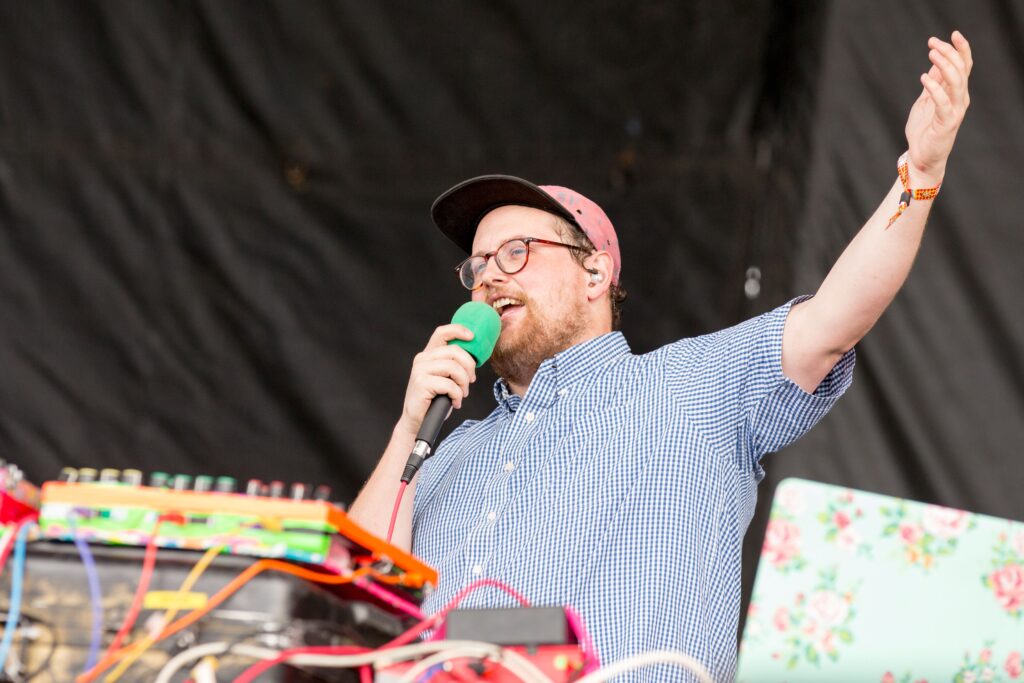
Baltimore-based electronic musician Dan Deacon delivered a groundbreaking and polarizing performance of “The Star-Spangled Banner” at the Baltimore Orioles game against the New York Mets on July 10, 2025. Deacon, known for his experimental and electronic compositions, brought his unique style to Camden Yards, leaving the audience with mixed reactions. His rendition of the national anthem featured a vocoder setup and heavy use of autotune, resulting in a sound far from the traditional a cappella version expected by many. This performance quickly went viral, prompting diverse opinions from fans and spectators alike.
Deacon’s approach to the national anthem was described as mesmerizing by some, who appreciated the innovative take. Using electronic elements, he started the anthem in a customary manner but quickly transitioned into a series of harmonies and layered effects, culminating in a growling shout of “O say,” which likely resonated with fans of Baltimore’s Orioles, colloquially known as the “O’s.” This particular embellishment highlighted a local tradition, with fans customarily emphasizing the “O” in “Oh” during the anthem. However, despite this nod to local culture, not everyone was enamored with the avant-garde version. Some attendees and viewers voiced their confusion and displeasure online, labeling the performance as a “disgrace to America.”
The mixed reception underscored a broader divide in public taste, pitting traditional expectations against modern interpretations. On social media, reactions ranged from ardent support to vehement criticism. One fan defended the rendition, asserting that no “Dan Deacon slander would be tolerated,” while others were baffled and criticized the performance as unpatriotic. A clip of the performance shared by Deacon on Instagram, captioned “Go Os,” suggested that the musician himself was proud of the bold artistic choice.
This was not the first time Deacon had ventured into these waters; he has built a reputation around his experimental work, continuously pushing boundaries in both live performances and recorded compositions. His latest project before the anthem was scoring the soundtrack for “Venom: The Last Dance,” indicating his active role in blending music with visual media.
The event sparked a broader conversation about the role of tradition in public performances and the acceptance of innovative interpretations of national symbols. While Deacon’s approach may have seemed unconventional, it also challenged audiences to reconsider the spaces within which national identity and artistic freedom intersect. By using electronic music — a form historically associated with rebellion and innovation — Deacon’s performance was a statement on both personal and national levels, asking hard questions about comfort zones and cultural conformity.
Interestingly, the Orioles not only embraced Deacon’s creativity but also saw victory on the field, defeating the New York Mets 7-3 in what some might call a serendipitous series of events. Baltimore’s fans further solidified their loyalty by adopting the tradition of over-pronouncing the “Oh” in the anthem, akin to their love and support for the Orioles. This local twist in tradition gave the occasion an added layer of cultural significance, celebrating both city and team.
The reaction to Deacon’s anthem displayed a microcosm of a larger cultural conversation about jury-rigging tradition with modernity, showing how art can be a polarizing force in societies governed by strong patriotic sentiments. Whether seen as a beneficial challenge to conventionality or a step too far, Dan Deacon’s performance remains a memorable moment in the intersection of music, sports, and national identity, sparking debate and reflection on the evolving landscape of cultural performances. With the Orioles claiming victory that day, the narrative of association between creativity and team spirit may well enshrine Deacon’s rendition in the local lore, a feat of reconciling communal identity through music.
Key Takeaways
-
www.stereogum.com | Dan Deacon performed a unique electronic rendition of the National Anthem at a Baltimore Orioles game, which was met with mixed reactions from the audience.
-
consequence.net | Dan Deacon used a vocoder and heavy autotune in his performance of the National Anthem, adding a unique electronic twist to the traditional song.
-
www.dailymail.co.uk | The performance by Dan Deacon at the Orioles game led to a heated debate among attendees and online viewers regarding the unconventional rendition.
-
www.dailymail.co.uk | This controversial rendition of the National Anthem by Dan Deacon at the Orioles game was described by some as a 'disgrace to America.'
-
www.stereogum.com | Baltimore Orioles defeated the New York Mets 7-3 on the day Dan Deacon performed the National Anthem.
-
www.stereogum.com | Dan Deacon has not released a traditional studio album since 2020 but has been actively involved in scoring films and releasing soundtrack albums.
TOP STORIES
RELATED ARTISTS
Related Stories
Alice Cooper Opens Up on Crack Addiction That Nearly Killed Him and Nearly Ended His Marriage
Alice Cooper’s new memoir ‘Devil on My Shoulder’ and a companion interview with The Telegraph detail how his crack cocaine use in the late 1970s and early 1980s brought him close to death and nearly cost him his marriage.
Roger Waters and Son Harry Waters Launch Pink Floyd Tribute Tour ‘LEGACY’ for 2027
AEG Presents and ICON LIVE have announced ‘Roger Waters Presents LEGACY: A Pink Floyd Show,’ a new touring production led musically by Harry Waters and launching February 15, 2027 in Columbus, Georgia.
Brian May Says Queen’s Touring Days Are Over
Brian May says he and Roger Taylor quietly agreed a year and a half ago that Queen would not tour again, a choice shaped by the death of a close family friend while the band was on the road in America.
Slash Announces 2027 World Tour and New Album ‘Flying Blind’ With Myles Kennedy
Slash has unveiled a 2027 world tour with Myles Kennedy and The Conspirators and a new album, ‘Flying Blind,’ marking his first dedicated run with the band since 2024.
Michael McDonald Reunites With Son Given Up for Adoption Nearly 60 Years Ago
A St. Louis man named Michael Goessling has learned that Doobie Brothers singer Michael McDonald is his biological father, nearly 60 years after being given up for adoption as an infant.
Metallica Kicks Off ‘Life Burns Faster’ Residency at Las Vegas Sphere
Metallica’s “Life Burns Faster” residency opens at the Las Vegas Sphere on October 1, 2026, running through March 2027 with 24 shows, a merch collaboration with adidas and a lineup of fan events across the city.
Rod Stewart Announces Retirement From Touring, Reveals 2027 ‘The Final Encore’ Tour Dates
Rod Stewart says his upcoming 2027 tour of the UK and Europe, called The Final Encore, will be his last time touring, though he insists he isn’t stepping away from music entirely.
Jo Wood Says Rolling Stones Touring Days May Be Done Because of Keith Richards
Jo Wood, Ronnie Wood’s ex-wife, says she doubts the Rolling Stones will hit the road again, blaming Keith Richards’ hesitance even as the band’s new album Foreign Tongues thrives.
Rush’s Geddy Lee, Alex Lifeson Push Neil Peart Memorial Fund Past $1 Million Goal
Rush’s Geddy Lee and Alex Lifeson delivered a $785,000 check to the Neil Peart Commemorative Task Force, putting a years-long campaign to build the late drummer’s memorial in Ontario over its $1 million target.