

How Buddy Guy Inspired Eric Clapton to Leave the Bluesbreakers and Form Cream

Clapton recalled that seeing what Guy could do as a lead guitarist convinced him a trio format was possible.
Eric Clapton's decision to leave John Mayall's Bluesbreakers and co-found Cream — one of rock's first and most celebrated power trios — was directly inspired not by the established blues legends of an older generation, but by a contemporary American guitarist: Buddy Guy. In a 2005 interview, Clapton recalled that Guy's approach showed him that a single guitarist could lead a band as a trio, and that the format could be liberating rather than limiting.
John Mayall's Bluesbreakers: The Proving Ground of a Generation
Before Clapton became a household name, he was one of several extraordinary musicians passing through the ranks of John Mayall's Bluesbreakers, the premier outfit of London's tightly knit 1960s blues scene. The band functioned almost as a finishing school for talent that would go on to define rock history. Peter Green, Mick Taylor, John McVie, and Mick Fleetwood all served time under Mayall's direction before finding their own paths to fame.
Clapton's tenure with the Bluesbreakers is widely regarded as the period that sharpened his virtuosity and deepened his command of the blues idiom. He absorbed the foundational work of masters like BB King and Muddy Waters, then pushed that vocabulary further, developing a style that felt both rooted and forward-looking. But the Bluesbreakers' structure, however formative, eventually felt like a constraint rather than a launching pad.
Buddy Guy: The Contemporary Who Changed Everything
When Clapton reflected on the influences that drove him to break away, he pointed not to the elder statesmen of the blues but to Buddy Guy. In a 2005 interview, Clapton described Guy as someone who ‘did far more than just hold his own,' adding, in his own words, that ‘in my humble opinion, he stole the show.' The significance of Guy was twofold: he was a contemporary operating in the same modern space, and he demonstrated that a single guitarist could anchor and lead a band without the scaffolding of a larger ensemble.
Clapton was explicit about what that revelation meant for his ambitions. ‘What it said to me was this was possible,' he recalled. ‘If you were a good enough guitar player, you could do it as a trio. It seemed to be so free, you could go anywhere. With Jack [Bruce] in my filing cabinet, and being in a fairly rigid structure like John Mayall's band, I was thinking about that as a way of breaking free.' That line of thinking led directly to the formation of Cream alongside Bruce and Ginger Baker — a band that would redefine what a guitar-led trio could accomplish.
The Bridge Between Blues Tradition and Rock Innovation
What made Guy's influence so potent was that it didn't ask Clapton to abandon the blues tradition — it showed him how to carry it forward on his own terms. Guy built a bridge between the foundational work of the genre's architects and the possibilities of a new, freer format. For Clapton, Green, and the broader cohort of Mayall alumni, that bridge was the permission slip they needed to step out from under the Bluesbreakers' umbrella and pursue something more expansive.
Cream's subsequent impact on rock — their dense improvisational live performances, their chart success, and their elevation of the power trio as a legitimate and commercially viable format — is well documented. But the origin story, as Clapton told it, runs through a Chicago guitarist whose influence on British rock is still underappreciated relative to the musicians he helped set in motion.
What we know
- Eric Clapton named Buddy Guy as a primary inspiration for leaving John Mayall's Bluesbreakers and forming Cream.
- In a 2005 interview, Clapton said of Guy: ‘In my humble opinion, he stole the show.'
- Clapton stated that Guy's example showed him that ‘if you were a good enough guitar player, you could do it as a trio.'
- Clapton referenced Jack Bruce as someone he had ‘in my filing cabinet' while still in the Bluesbreakers, indicating he was already planning a new project.
- John Mayall's Bluesbreakers also included, at various points, Peter Green, Mick Taylor, John McVie, and Mick Fleetwood.
The take
The story of Cream's formation is usually told as a straightforward supergroup narrative — three virtuosos deciding to pool their talents — but Clapton's own account complicates that tidy version in an instructive way. The Buddy Guy connection places the band's origins squarely in the transatlantic blues dialogue that defined the British Invasion era. Guy, along with Otis Rush and Magic Sam, represented a younger, more aggressive Chicago blues style that hit British musicians differently than the Delta or Texas traditions. Where Robert Johnson or Muddy Waters offered mythology and foundation, Guy offered a live, contemporary model — proof that the music was still evolving and that a single guitarist could be the engine of something explosive.
For Clapton specifically, the trio format wasn't just an aesthetic choice; it was a philosophical one. The Bluesbreakers were a working band with a leader, a repertoire, and a structure. Cream was a statement about freedom and equal creative weight. That Clapton traced the idea back to watching Guy perform underscores how much the British blues boom owed to American artists who never received equivalent commercial recognition in their home country. Guy wouldn't win his first Grammy until 1991, decades after the musicians he inspired had become rock royalty. The influence ran deep and the credit, historically, ran shallow — which makes Clapton's direct acknowledgment all the more significant.
Why it matters
For Classic Rock listeners, the Clapton-Guy connection reframes one of the genre's foundational origin stories. Cream didn't emerge from a vacuum or purely from British blues ambition — the spark was lit by a living American bluesman whose work demonstrated what was possible. Understanding that lineage matters because it keeps the blues at the center of rock history where it belongs, and it gives Guy his proper place in the chain of influence that runs from Chicago's South Side to the stages of the Royal Albert Hall and beyond.
What's next
No specific upcoming events tied to this story are referenced in the source material. The account draws on a 2005 Clapton interview and serves as historical context for the formation of Cream and the broader legacy of John Mayall's Bluesbreakers alumni.
Frequently asked questions
Why did Eric Clapton leave John Mayall's Bluesbreakers?
Clapton described the Bluesbreakers as ‘a fairly rigid structure' and said that seeing Buddy Guy perform convinced him that a guitarist could lead a band as a trio, which he saw as ‘a way of breaking free.'
Who inspired Eric Clapton to form Cream?
Clapton credited Buddy Guy as the key inspiration, saying Guy demonstrated that a single guitarist could front a trio and that the format could be musically free and wide-ranging.
What did Eric Clapton say about Buddy Guy?
In a 2005 interview, Clapton said Guy ‘did far more than just hold his own' and that ‘in my humble opinion, he stole the show.'
Who else came out of John Mayall's Bluesbreakers?
Among the musicians who passed through the Bluesbreakers were Peter Green, Mick Taylor, John McVie, and Mick Fleetwood, all of whom went on to significant careers in rock.
Who was Jack Bruce and what was his connection to Cream's formation?
Jack Bruce was a musician Clapton referenced as someone he already had ‘in my filing cabinet' while still in the Bluesbreakers; Bruce went on to become the bassist and a co-founder of Cream.
TOP STORIES


Related Stories
Metallica Defies Principality Stadium Ban, Performs Tom Jones’ ‘Delilah’ in Cardiff
Metallica defied a standing ban at Cardiff’s Principality Stadium by performing Tom Jones’ ‘Delilah’ during their M72 World Tour stop in Wales.
Peter Gabriel Releases ‘I Belong to the Sky,’ Seventh Track from Upcoming Album o/i
Peter Gabriel has released ‘I Belong to the Sky,’ the seventh full-moon single from his upcoming album o/i, featuring drummer Manu Katché and artwork by
Bruce Springsteen Eulogizes Clive Davis: ‘He Changed My Life Forever’
Bruce Springsteen delivered a moving eulogy at Clive Davis’s New York funeral, recalling how the legendary executive signed him to Columbia Records in 1972.
Bob Britt Talks About Why He Quit Dylan’s Band as Joel Paterson Steps In
Guitarist Bob Britt has quit Bob Dylan’s Long Hot Summer Tour ’26 mid-run, saying he left of his own accord. Joel Paterson has been recruited to fill the
ZZ Top and Cheap Trick Extend 2026 Tour With New European and U.S. Dates
ZZ Top and Cheap Trick have added new dates to their 2026 tour, including European stops and rescheduled U.S. shows. Presale begins July 1 with code CTLIVE.
Bob Dylan Loses Two Guitarists Mid-Tour as Bob Britt Quits
Bob Dylan’s acoustic guitarist Bob Britt quit mid-tour with a cryptic ‘Sayonara Bobby’ post, while electric guitarist Doug Lancio also quietly departed the
Stevie Nicks Expected to Perform at Taylor Swift’s MSG Wedding
Rolling Stone reports Stevie Nicks is expected to perform at Taylor Swift and Travis Kelce’s rumored Fourth of July wedding at Madison Square Garden.
B-52s Blame Promoter After Tornado Destroys Gear at French Festival
The B-52s narrowly avoided catastrophe at the Retro C Trop festival in France after a tornado struck the venue, destroying keyboards, laptops, and more gear.
Metallica Donate £20,000 to Cardiff Foodbank Through All Within My Hands Foundation
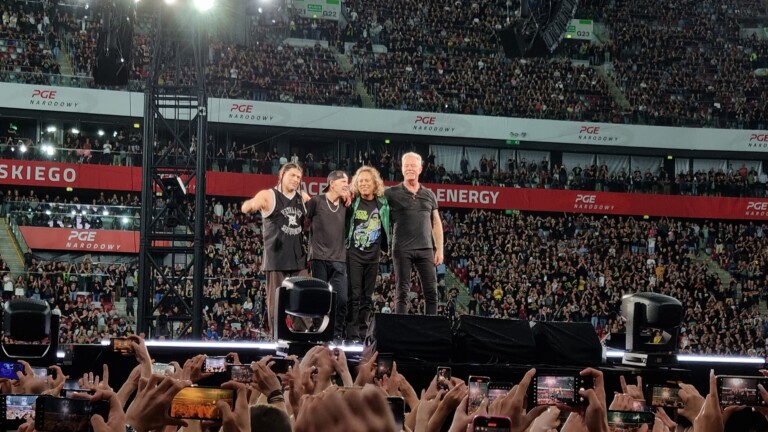
Metallica donated £20,000 to Cardiff Foodbank through their All Within My Hands foundation after a sell-out M72 World Tour date at the Welsh capital on June 28.